What a Valorant lowest to highest rank challenge reveals about climbing in 2026
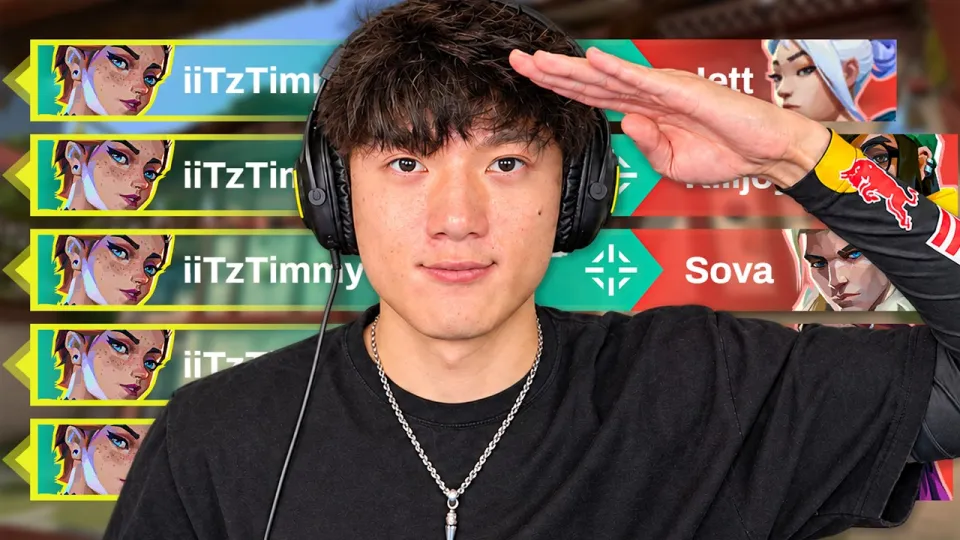
Video: I Might Be Getting TOO Good at Valorant… (Lowest To Highest Rank Challenge)
Need articles like this for your video? They help promote it on YouTube and Google — order them in the Telegram bot @sat_sit_bot. The bot writes and publishes the articles itself (with your YouTube video embedded) on popular topical websites (no ads). Your first 50 articles are free.
· based on the channel iiTzTimmy Two
Key takeaways
- The lowest to highest rank challenge starts a fresh or low-ranked account and climbs toward Radiant, Valorant's top rank above Immortal.
- Valorant's competitive ladder runs Iron, Bronze, Silver, Gold, Platinum, Diamond, Ascendant, Immortal and Radiant.
- Rank Rating (RR) gains and losses swing with match MVP impact, round differential and the hidden MMR of both teams.
- In the iiTzTimmy Two video, a Cypher teammate tilts over missing comms while a Reyna ends up being the calm voice on the team.
- iiTzTimmy streams live at twitch.tv/iiTzTimmy, where the full runs and unedited matches air first.
A Valorant lowest to highest rank challenge is a climb from the bottom of the competitive ladder, usually Iron or a fresh account, all the way to Radiant, and it works as a stress test of fundamentals because every rank tier punishes a different weakness. The format has become one of the most-watched categories in Valorant streaming, and iiTzTimmy's run on his second channel is a clean example of how the challenge plays out in practice. You can follow the live version of these climbs on his Twitch channel, where the unedited matches air before they reach YouTube.
How the Valorant ranked ladder is actually structured
Valorant's competitive system stacks nine tiers, and understanding the order is the first step to understanding any lowest to highest rank challenge. From bottom to top: Iron, Bronze, Silver, Gold, Platinum, Diamond, Ascendant, Immortal and Radiant. Each tier below Immortal is split into three divisions, so a full climb from Iron 1 to Radiant crosses roughly two dozen promotion steps.
Two mechanics do most of the work in that climb:
- Rank Rating (RR). Every match moves your RR up or down. Wins add, losses subtract, and the size of the swing depends on round differential, your individual impact and the rating gap between the two teams.
- Hidden MMR. Matchmaking is driven by a separate skill rating, not your visible rank. A player with Radiant-level MMR on a low account gains RR extremely fast, which is why smurf climbs finish in dozens of games rather than hundreds.
That second point is the whole engine of the challenge format. A pro-level player does not grind through Silver for weeks; the system detects the mismatch and accelerates the account upward. The interesting part is not whether the climb finishes, but what breaks in the lobbies along the way.
What the iiTzTimmy Two run shows about low-rank lobbies
The iiTzTimmy Two video follows the challenge format the channel is known for: a low-ranked start, a long session, and the slow normalization of absurd individual stats. What stands out is not the aim. It is the team dynamics in the early games, where the skill gap between one player and nine others turns ordinary ranked matches into something closer to a social experiment.
The first game's Cypher became the unintended comic center of the video. He pushed into site first, died, and then blamed the team for it, while also complaining that he was not getting comms. Viewers picked up on the contradiction immediately: a player demanding information while making plays that ignore it. Later in the same match, the same player called out utility that had not been used, essentially inventing comms in his own head. Meanwhile, the Reyna, a duelist usually stereotyped as the most self-centered role on the roster, ended up being the reasonable voice on the team.
That inversion is the most useful takeaway from the low-rank portion of the run. Role stereotypes in Valorant are weak predictors of teammate quality; attitude is a much stronger one.
Why mentality decides more ranked games than aim
A tilted teammate costs more rounds in Valorant than a mechanically weak one, and the challenge format makes that visible because the same player keeps appearing in the kill feed. The Cypher in the opening match is a textbook case: bad positioning, followed by blame, followed by nitpicking every call the rest of the team made. Nothing about his aim was the problem.
Three habits separate players who climb from players who stall:
- Own the entry. If you are first onto site, the outcome is on you, not on the players who traded behind you.
- Use comms as information, not as evidence. Calling utility that was never used, or demanding comms you are not acting on, adds noise instead of value.
- Reset between rounds. A single lost pistol round should not change how you play the next five.
In low elo, these habits matter more than crosshair placement because everyone is making the same mechanical mistakes. The team that stops arguing first usually wins the economy game by default.
The mechanics that carry a climb from Iron to Radiant
Once the account reaches the middle tiers, individual skill stops being enough on its own and the climb becomes about repeatable decisions. The players who finish a lowest to highest rank challenge quickly tend to share the same core set:
- Default economy discipline. Buying with the team, saving together, and never forcing a buy that leaves four players on pistols.
- One agent pool. Two or three agents mastered beats ten agents played at 60 percent.
- Crosshair placement at head height on every angle. This is the single largest mechanical gap between Gold and Diamond lobbies.
- Utility before contact. Smokes and recon go down before the entry, not after the first death.
- Reviewing losses. Watching your own demos for five minutes catches more errors than an hour of aim training.
The challenge format compresses this learning curve because the player faces every tier in sequence. Each rank exposes the specific habit that tier rewards, and the climb only continues when that habit is fixed.
Common questions about rank climbs, smurfing and matchmaking
Ranked climbing in Valorant generates the same arguments every season, and the challenge videos tend to surface them all at once. The most frequent concerns are about whether high-level players ruin low lobbies, whether RR gains are fair, and whether a hardstuck account can be rescued.
On smurfing: Riot's matchmaking does adjust MMR quickly for accounts that win heavily, so a pro player passes through low elo in a small number of games rather than farming it for weeks. That does not make the experience pleasant for the opponents in those few games, which is why the format is usually framed as entertainment rather than a guide.
On RR: gains and losses are not random. A 13-2 win moves the bar further than a 13-11 win, and individual performance shifts the number further still. Players who consistently top-frag on losing teams often lose less RR than their scoreboard suggests they should.
On hardstuck accounts: a plateau is usually a decision-making plateau, not a mechanical ceiling. The fastest fix is narrowing the agent pool and reviewing losses, not buying a new mouse.
Useful links from the channel
- Live streams and full challenge runs: https://www.twitch.tv/iiTzTimmy
- Short updates and clips: https://twitter.com/iiTzTimmy
- Behind-the-scenes posts: https://www.instagram.com/iiTzTimmy/
- Short-form highlights: https://www.tiktok.com/@iiTzTimmy
- Community and LFG: https://discord.gg/iitztimmy
Final takeaway on the climb format
The lowest to highest rank challenge works as entertainment because it puts a top-tier player in rooms where the rules of engagement are completely different, and it works as a learning tool because every tier exposes a distinct weakness. The iiTzTimmy Two run is worth watching for the team dynamics as much as the aim: a tilted Cypher, a surprisingly level-headed Reyna, and a lobby that keeps trying to solve a problem it cannot see. If you want to see the next climb as it happens, watch live at twitch.tv/iiTzTimmy and compare your own ranked habits against what breaks in those lobbies.
Source: I Might Be Getting TOO Good at Valorant… (Lowest To Highest Rank Challenge) · Markdown version
Questions & answers
What rank do you start at in a Valorant lowest to highest rank challenge?
Most runs begin at Iron 1 on a fresh account, though some creators start from Unranked placements. The goal is always the same: reach Radiant, which sits above Immortal and has no divisions.
How long does it take to climb from Iron to Radiant in Valorant?
For a player with Radiant-level MMR, the hidden rating accelerates RR gains heavily, so the visible climb can finish in a few dozen matches. A genuinely new player should expect hundreds of games, since the system needs evidence before it moves the account quickly.
Does individual performance affect RR gains in Valorant?
Yes. Round differential and individual impact both shift the RR number, alongside the rating gap between the two teams. A dominant 13-2 win moves the bar further than a narrow 13-11 result.
Why do high-rank players get matched with low-rank opponents during these challenges?
Matchmaking uses hidden MMR rather than visible rank, and it adjusts fast after dominant results. That is why a pro passes through low elo quickly instead of staying there, though the opponents in those games still get an unpleasant match.